
The Sim
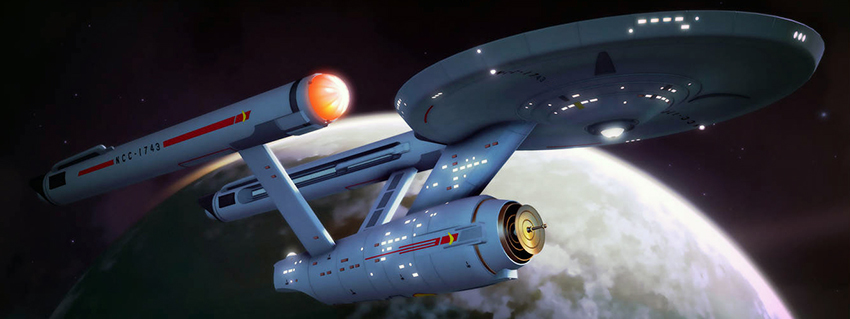
Starship Midway is a Star Trek simulation set in 2268, during the final years of the era depicted in The Original Series. Its focus is the USS Midway (NCC-1743), one of Starfleet’s newest Constitution-class starships and one of the last completed before the class begins its major refit program.
Launched ahead of schedule following the loss of the USS Defiant, Midway is assigned to operate in and around the Triangle: a politically unstable region where Federation, Klingon, and Romulan interests collide. Starfleet’s purpose is larger than patrol duty. Midway is expected to explore, protect Federation interests, support friendly and aligned worlds, respond to crises, and demonstrate that the Federation can be a stabilizing presence without turning the frontier into an occupied territory.
That assignment places the ship at the center of a region where almost every action carries political consequences.
The Triangle
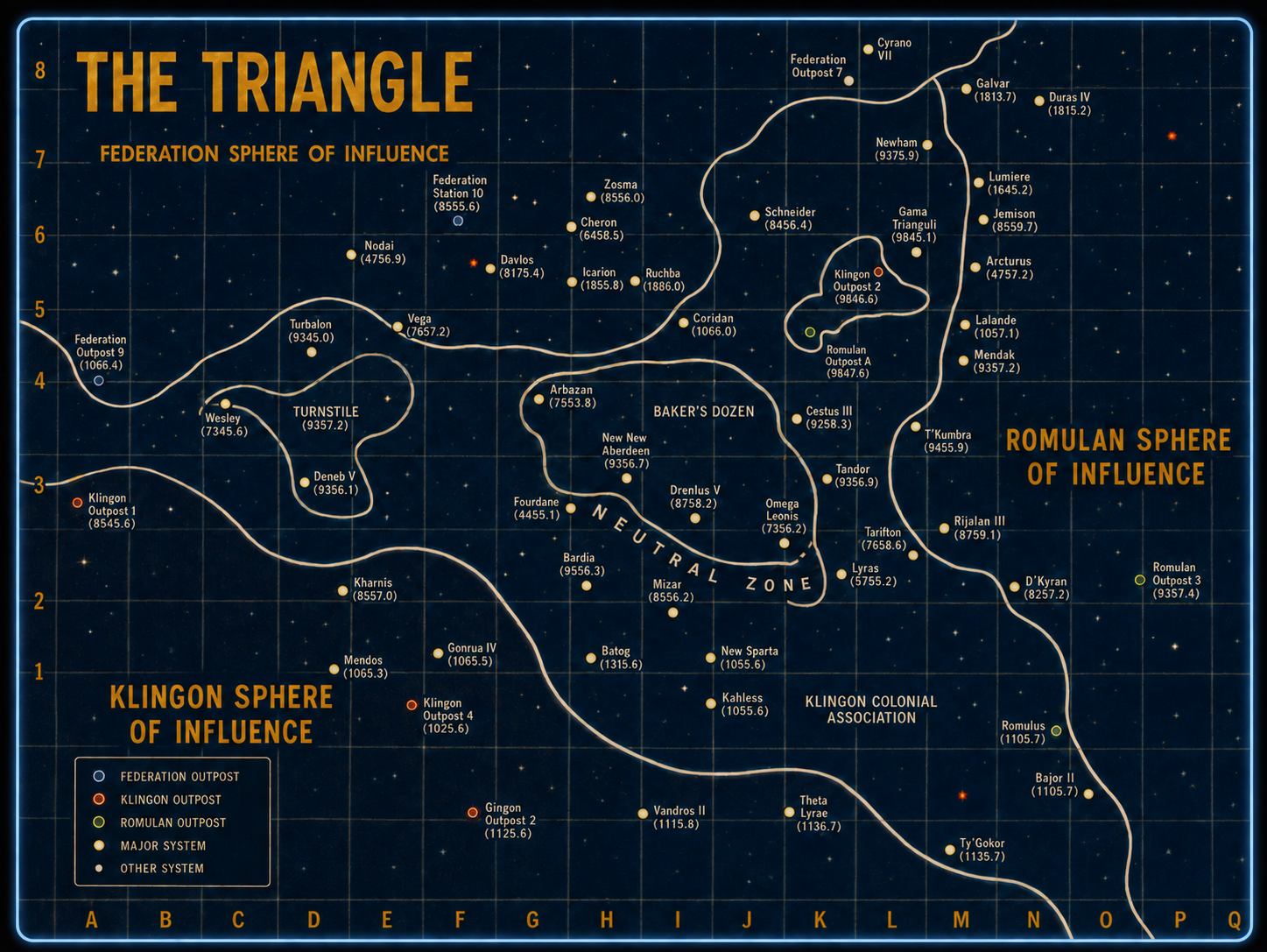 The Triangle is Midway’s home territory and the primary engine of the simulation.
It is not simply a dangerous stretch of space between three great powers. It is a collection of independent worlds, protectorates, colonies, trade routes, disputed systems, criminal enclaves, and resource-rich territories whose futures are still being decided. Federation law does not reach everywhere. Klingon and Romulan authority is similarly limited, and each power has reasons to influence events without openly provoking the others.
That ambiguity creates room for smugglers, Orion cartels, private interests, intelligence services, mercenaries, local governments, and ambitious individuals to operate between the cracks. A freighter hijacking may be piracy—or part of a larger political operation. A mining dispute may conceal a territorial claim. An independent government may genuinely want Federation help while fearing what Federation protection could eventually cost.
The Triangle therefore gives Midway a recurring world rather than a collection of disconnected destinations. Missions can change relationships, shift local politics, create enemies and allies, and leave consequences that matter when the ship returns. The Triangle should increasingly feel like a place the crew knows: not safe, not predictable, but familiar enough that returning to a world or encountering an old adversary carries history with it.
The Midway’s Role
The USS Midway is not simply passing through the Triangle. Its presence is itself a political event.
A Constitution-class starship represents some of the Federation’s greatest scientific, diplomatic, and military capability. Assigning one of the newest ships of the class to this region sends a message whether Starfleet intends one or not. Federation allies may see reassurance. Independent worlds may see opportunity or pressure. Klingon and Romulan observers may see an attempt to change the balance of power.
Midway must therefore accomplish its mission without becoming the very threat its rivals claim it represents.
That tension helps define the ship’s role. The crew may be explorers one week, diplomats the next, and the only force capable of stopping a major threat the week after that. Force is sometimes necessary, but it is rarely politically simple. The best solution is not always the cleanest one, and victory may mean preventing a crisis rather than defeating an enemy.
Story Philosophy
 Starship Midway combines the optimism of Star Trek (1966–1969) with the more complicated political and moral environment associated with Star Trek: Deep Space Nine (1993–1999).
The Federation’s ideals are real. Exploration, cooperation, reason, tolerance, and peaceful progress are not treated as naïve slogans waiting to be disproven. At the same time, Midway operates in a setting where living up to those ideals can be difficult. Other governments have legitimate interests. Local populations have their own histories and priorities. Starfleet officers can misjudge situations. Good intentions can produce unintended consequences. We are interested in asking what those ideals require when following them is inconvenient, dangerous, or costly.
The result should still feel fundamentally hopeful. Cynicism may exist in individual characters or institutions, but cynicism is not the worldview of the simulation. The universe can be harsh without becoming hopeless, and difficult compromises should make successful acts of courage, compassion, restraint, and understanding more meaningful rather than less.
Tone & Style
Starship Midway should feel adventurous, intelligent, character-driven, and occasionally strange.
The series has room for exploration, mystery, diplomacy, espionage, frontier crime, political tension, scientific discovery, humor, horror, action, and personal drama. A mission may involve an unknown phenomenon one month and a covert Romulan operation the next. What connects these stories is not a rigid genre formula but the ship, its crew, and the evolving world around them.
Serious consequences are welcome, but the simulation should not become relentlessly grim. Star Trek has always allowed wonder and humor to exist beside danger. Characters should have friendships, rivalries, hobbies, romances, professional ambitions, and ordinary shipboard lives. Those quieter moments help make the larger crises matter.
Likewise, adversaries should have motives rather than exist only to be defeated. Klingons, Romulans, Orions, criminals, and independent political actors are not interchangeable villains. Their interests may conflict with the Federation without making every individual malicious. Some conflicts should be solvable through understanding; others should reveal that understanding an opponent does not necessarily make that opponent less dangerous.
A Living Setting
Midway is designed around continuity without requiring every mission to be part of one uninterrupted story arc.
Places can recur. NPCs can return. Political decisions can have consequences several missions later. A minor criminal organization can become a major threat. A diplomatic success can create a new obligation. Damage to the ship, changes in command relationships, and the reputation Midway develops in the Triangle should all help create the sense that events accumulate.
Not every story must advance a master plot. Stand-alone adventures are important. The goal is simply for them to occur in a universe that remembers what happened.
Continuity & Canon
Midway is rooted in the world, technology, and visual language of the late Original Series era and draws naturally from Star Trek: The Animated Series (1973–1975) and the transition toward the Star Trek: The Motion Picture era. Established Star Trek continuity provides the foundation, while gaps in canon provide room for the simulation to create its own worlds, politics, characters, and history.
Material from sources such as FASA’s Star Trek: The Role Playing Game (1982–1989) or Star Fleet Battles (1979) may be used as inspiration where it strengthens the setting, but it is not binding.
Canon should be a foundation rather than a cage. Midway has revisited unresolved ideas or consequences from Star Trek, but the simulation is not built around sending the crew from one familiar canon reference to the next. Its identity comes from the Triangle, the Midway, and the characters who live there.
How We Tell Stories
Starship Midway is an ensemble simulation. The commanding officer may make the final decision, but missions should create meaningful work for officers throughout the ship. Science, medicine, engineering, security, operations, diplomacy, and junior officers should all have opportunities to influence events.
Character stories work best when they grow out of the mission rather than competing with it. Relationships, personal conflicts, ambitions, mistakes, and growth give the larger plot emotional weight. At the same time, the mission should continue moving forward; the ship and the situation around it remain the shared stage on which individual stories occur.
Writers are encouraged to add details, complications, minor characters, and consequences that make the setting richer, while respecting established characterization and leaving room for other players to respond. The best stories feel collaborative: no single post needs to contain the entire answer, and the most interesting outcomes often emerge from characters approaching the same problem from different perspectives.